
2026 Peak Season LTL Shipping Guide: Rates, Surcharges, and Key Dates
Peak season 2026 is the most expensive LTL shipping season on record. The LTL rate per pound index sits 82.5 percent above the January 2018 baseline, fuel surcharges are up 79 percent year over year, and diesel hit an all time high of $6.53 per gallon in September. Book early, verify your freight class, and ship before Thanksgiving week to control costs.
Why Is Peak Season 2026 Different for LTL?
Three forces are hitting LTL shippers at once this year. First, rates are at record highs. The TD Cowen and AFS Freight Index for the third quarter of 2026 shows the LTL rate per pound index at 82.5 percent above the January 2018 baseline.
That is up 8.8 percent from last year and the third straight record quarter, according to AFS Logistics. Second, fuel costs are crushing. LTL fuel surcharges rose 79 percent compared to September 2025.
Diesel peaked at an all time high of $6.53 per gallon in September 2026, per the same index.
AFS notes that most of the fuel surcharge increase since 2021 comes from carrier table changes, not just pump prices. Third, capacity is tight. Tender rejections hit 13.6 percent, and about 50,000 carriers left the market in the past 12 months, according to data reported by Commercial Carrier Journal.
When carriers get selective, shippers with sloppy paperwork get pushed to the back of the line.
2026 Peak Season Dates That Matter for LTL Shippers
| Date | What Happened |
|---|---|
| November 26, 2026 | Thanksgiving. Most LTL terminals close. Freight picked up Wednesday may sit until Monday. |
| Week of November 23 | Thanksgiving blackout week. Avoid shipping unless you must. Transit times stretch by 2 to 4 days. |
| December 12, 2026 | NMFC Supplement 2026-2 takes effect. New freight classes apply to more commodities. |
| December 24 to 25, 2026 | Christmas. Terminals close. Plan pickups for December 21 or earlier. |
| December 31 to January 1 | New Year. Terminals close again. January capacity is thin as drivers take time off. |
How Much More Will LTL Cost This Peak Season?
Take a real example. A furniture maker in High Point, North Carolina ships 4 pallets of boxed chairs to a retail distribution center in Dallas. Each pallet weighs 600 pounds and measures 48 by 40 by 60 inches.
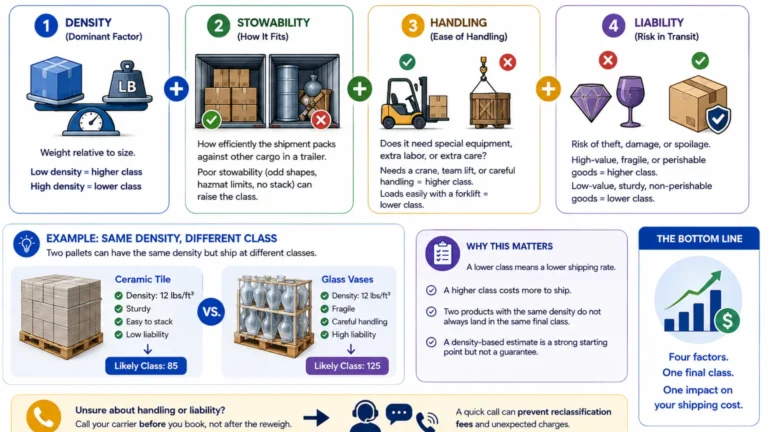
Total weight is 2,400 pounds. Total cubic feet is about 267. Density is 9 pounds per cubic foot, which maps to Class 100 on the density scale.
| Cost Item | October Shipment | Peak Week Shipment |
|---|---|---|
| Base rate, 4 pallets, Class 100 | $950 | $1,000 to $1,025 |
| Peak premium (5 to 8 percent) | $0 | $50 to $75 |
| Reclassification risk adder | Lower | Higher (carriers inspect more) |
| Cost for 20 December loads | $19,000 | $20,000 to $20,500 |
The math gets worse if your freight class is wrong. A shipment quoted at Class 100 that gets reinspected and bumped to Class 150 can cost several hundred dollars more per load. Peak season is when carriers inspect most aggressively.
Where Will LTL Terminals Get Congested?
Holiday freight piles up at the same choke points every year. Expect the heaviest congestion at LTL terminals in Chicago, Dallas Fort Worth, Atlanta, and Southern California.
Chicago is the busiest LTL crossroads in the country, where freight moving on the I-55, I-80, and I-90 corridors transfers between carriers. Dallas Fort Worth handles the surge of retail freight heading into Texas distribution centers along I-20 and I-35.
Atlanta serves the Southeast retail corridor on I-75 and I-85. Southern California terminals back up as import freight from the ports of Los Angeles and Long Beach converts to domestic LTL moves.
If your freight must pass through one of these hubs, add two extra transit days to your plan. Book pickups early in the week. Freight tendered on Thursday or Friday before a holiday weekend is the most likely to sit.
Your Week by Week Peak Season Checklist
Late October: audit and prepare. Verify the freight class of your top 10 commodities. Measure pallets as they actually ship.
Update your bills of lading. Confirm your carrier’s holiday schedule and pickup cutoff times.
Early November: book ahead. Tender December freight now if you can. Ask your carrier about guaranteed or expedited LTL options for must hit dates.
Build a backup carrier list in case your primary gets full.
Thanksgiving week: avoid shipping. If you must ship, tender on Monday and expect delivery the following week. Do not promise customers delivery dates across the holiday.
Early December: watch the NMFC date. Supplement 2026-2 takes effect December 12. If any of your commodities changed class, your December 13 shipment rates differently than your December 11 shipment.
Confirm with your carrier.
Christmas and New Year: ship early or wait. Last safe pickup dates are usually December 21 for Christmas delivery and December 28 for year end. After that, hold freight until January 4 if you can.
How to Become a Shipper of Choice When Capacity Is Tight
When terminals fill up, carriers pick which freight moves first. Shippers of choice get their loads accepted. Here is how to earn that status.
First, get your paperwork right. Accurate weights, dimensions, and freight class on every bill of lading. Nothing slows a shipment like a reweigh dispute at a busy Chicago terminal in December.
Second, be flexible on appointments. If your warehouse near the I-285 loop in Atlanta can accept a 6 AM delivery instead of insisting on 2 PM, say so. Flexibility gets you loaded faster.
Third, keep your freight easy to handle. Stacked, stretch wrapped, clearly labeled pallets move through a terminal in minutes. Loose boxes and leaning stacks get set aside.
Fourth, communicate early. Tell your carrier about December volume spikes now, not the week they hit. A heads up in October is worth more than a panic call in December.
Frequently Asked Questions
When is LTL peak season 2026?
LTL peak season runs from October through December. The tightest capacity falls in the last two weeks of November and the last two weeks of December. Thanksgiving week and the Christmas to New Year stretch see terminal closures and the longest delays.
How much do LTL rates go up during peak season?
Expect a 5 to 8 percent premium over October rates on most lanes, on top of already record base rates. The LTL rate per pound index was 82.5 percent above the January 2018 baseline in Q3 2026, per the TD Cowen and AFS Freight Index.
Should I ship LTL the week of Thanksgiving?
Avoid it if you can. Most LTL terminals close on Thanksgiving Day, and freight picked up that Wednesday often sits until the following Monday. Tender on Monday of Thanksgiving week at the latest, and add 2 to 4 days to normal transit times.
Does the December 12 NMFC change affect my peak shipments?
It can. Supplement 2026-2 takes effect December 12, 2026, moving more commodities to density based classification. A shipment tendered December 13 may rate at a different class than the identical shipment tendered December 11.
Verify your classes before that date.
How do I avoid reclassification fees during peak season?
Measure every pallet as it actually ships. Confirm the freight class with our freight class calculator or the NMFTA ClassIT tool. Print the correct class on the bill of lading.
Carriers inspect more aggressively when terminals are full.
Sources
- AFS Logistics, Q4 2026 TD Cowen and AFS Freight Index press release (October 13, 2026) – afs.net
- GlobalTranz, 9 Freight Peak Season Challenges for 2026 (October 15, 2026) – globaltranz.com
- Commercial Carrier Journal, Truckload Rates Hit 4 Year High (August 2026) – ccjdigital.com
- NMFTA, 2026-2 Disposition Bulletin (October 9, 2026) – nmfta.org
One Comment