Amazon LTL and the FedEx Freight Spinoff: What Shippers Should Do Now
In June 2026, two shocks hit the LTL market nine days apart. FedEx completed the spinoff of FedEx Freight as an independent company on June 1, and Amazon opened its LTL network to all US businesses on June 10. Shippers should audit bundled parcel plus LTL contracts, benchmark Amazon on 1 to 6 pallet lanes, and watch whether the new competition lowers rates through 2027.
What Happened: A Timeline
| Date | Event |
|---|---|
| April 2025 | Amazon launched limited LTL service for inbound freight to its own facilities |
| June 1, 2026 | FedEx completed the spinoff of FedEx Freight, now trading on the NYSE as FDXF |
| June 10, 2026 | Amazon opened full scale LTL shipping to all US businesses |
| October 2026 | Amazon added LTL labels through its Buy Shipping program for sellers |
| Early 2027 | Amazon plans regional delivery pricing for its LTL service |
What Is Amazon LTL?
Amazon LTL is Amazon’s less than truckload freight service, open to all US businesses since June 10, 2026. It handles shipments of 1 to 6 pallets weighing 150 to 15,000 pounds.
Amazon brings serious assets: more than 80,000 trailers and 24,000 intermodal containers, according to the company. Industry analyst Jason Seidl of TD Cowen counts about 74 cross dock facilities in the network as of early 2025, with inbound operations at roughly 115 facilities, as reported by FreightWaves.
When Amazon announced the full launch, LTL carrier stocks dropped the same day. Old Dominion fell 5 percent, ArcBest 4 percent, FedEx Freight 7 percent, Saia 3 percent, and XPO 5 percent, according to CNBC reporting. The market read the news as a real competitive threat.
Not everyone agrees on what Amazon is. ShipMatrix president Satish Jindel argues Amazon is acting as a broker, not a carrier. He says the company lacks its own drivers, trucks, and terminals in the traditional sense.
Amazon disputes this and describes an asset backed operation.
For a shipper, the label matters less than the rate and the service. Test both before you judge.
What Is the FedEx Freight Spinoff?
On June 1, 2026, FedEx completed the separation of FedEx Freight into an independent publicly traded company. It trades on the New York Stock Exchange under the ticker FDXF.
FedEx distributed 80.1 percent of the shares to its stockholders, one FDXF share for every two FedEx shares held, and kept 19.9 percent to sell later, according to the FedEx newsroom.
FedEx Freight is the largest LTL carrier in the US. For its fiscal fourth quarter of 2026, it reported revenue of 2.4 billion dollars, up 4.8 percent, with average daily shipments of 86,700 and revenue per shipment of $415.22, up 11.5 percent, according to Business Wire.
AFS Logistics analyst Mich Fabriga captured why this matters: the spinoff frees FedEx Freight to compete more aggressively without the constraints of its parcel business, as reported by Commercial Carrier Journal. An independent FedEx Freight can price LTL on LTL economics instead of protecting parcel relationships.
How Do the Two Stories Connect?
These are not two separate news items. They are two sides of one market shift. Amazon is adding LTL capacity from the outside while FedEx Freight is unleashing itself from the inside.
Together, they put pressure on every incumbent LTL carrier to defend share on price and service. For shippers, the practical question is simple: does more competition mean lower rates?
In the short term, probably not much. LTL rates remain at record highs, with the TD Cowen and AFS index at 82.5 percent above the January 2018 baseline in Q3 2026. But new capacity and hungrier competitors give shippers something they lacked for years: leverage in negotiations.
Carrier Comparison: Your LTL Options Now
| Carrier | Profile | Best Fit |
|---|---|---|
| Amazon (LTL service) | New national entrant, 1 to 6 pallets, asset backed network, economy lane focus with 3 to 4 day windows | Shippers with regular 1 to 6 pallet lanes who can plan around longer transit |
| FedEx Freight (FDXF) | Largest US LTL carrier, now independent, aggressive pricing expected | Shippers who want national coverage with a carrier free to compete on LTL terms |
| Old Dominion | Premium service reputation, best on time record in the industry | Shippers who rank service and low claims above lowest price |
| XPO Logistics | Large national network, strong in the Midwest and Northeast corridors | High volume shippers who can negotiate committed rates |
| Saia | Growing southeastern and south central coverage, expanding west | Regional shippers in the South, especially Texas and the Southeast |
| Estes | Large private carrier, strong East Coast and Midwest presence | Shippers wanting a non union alternative with broad coverage |
The Bundled Contract Risk Nobody Talks About
Many shippers buy parcel and LTL together from FedEx under one bundled discount. That bundle assumed one FedEx. Now FedEx Freight is a separate company with its own P and L.
The discount logic behind your contract may no longer hold.
Pull your FedEx contract and check how the LTL discount ties to parcel volume. If the LTL rate depends on parcel spend commitments, model what happens if you move parcel volume to UPS or a regional carrier.
You may find the LTL discount was subsidizing the parcel side, or the other way around. Either way, renegotiate with full information instead of renewing on autopilot.
What Small Shippers Should Do This Quarter
- Benchmark Amazon on your best lanes. If you regularly move 1 to 6 pallets between, say, your Chicago warehouse and customers along the I-80 corridor, get an Amazon LTL quote and compare it to your current carrier. One quote costs nothing.
- Audit your FedEx bundle. Separate the parcel discount from the LTL discount on paper. Know what each is really worth before your next renewal.
- Watch service data for 60 to 90 days. Amazon’s network is new at national scale. Track on time performance and damage rates before moving real volume, the way you would vet any new carrier on the I-95 corridor or anywhere else.
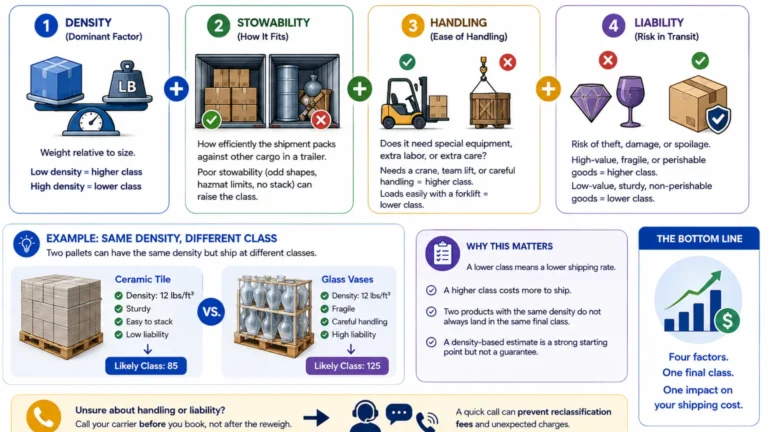
- Keep your freight class accurate. New carriers quote on density. If your class is wrong, every quote you compare is wrong too. Verify with a freight class calculator first.
- Do not panic about disruption. Old Dominion’s CEO called Amazon’s entry an opportunity to win business, not a threat. May 2026 revenue per day rose 12.3 percent year over year even as the news landed. Incumbents still hold the densest networks.
Frequently Asked Questions
Is Amazon LTL cheaper than Old Dominion or XPO?
It depends on the lane. Amazon skews toward economy lanes with 3 to 4 day transit windows, where its asset network gives it cost advantages. On time sensitive or remote lanes, incumbents like Old Dominion often win on service.
Get quotes on your actual lanes instead of assuming, and confirm your freight class before you compare rates.
Will my FedEx Freight rates change after the spinoff?
Your existing contract terms stay in force, but renewals will reflect an independent FedEx Freight pricing LTL on its own economics. If your discount was bundled with parcel volume, expect that structure to be revisited. Review the contract before renewal.
Is Amazon a freight broker or a carrier?
Amazon describes an asset backed operation with 80,000 plus trailers and 24,000 intermodal containers. Critics like ShipMatrix argue it functions more like a broker without traditional terminals and drivers. For shippers, the practical test is rate, transit time, and claims performance on your freight.
When did FedEx Freight become independent?
June 1, 2026. It trades on the NYSE as FDXF. FedEx distributed 80.1 percent of shares to stockholders and retained 19.9 percent.
Should small shippers try Amazon LTL?
Yes, as a benchmark at minimum. If you ship 1 to 6 pallets on repeat lanes, an Amazon quote gives you leverage with your current carrier even if you never tender a load. Watch service metrics for a few months before committing volume.
Sources
- FreightWaves, Amazon opens full scale less than truckload shipping to all businesses (June 10, 2026) – freightwaves.com
- FedEx Newsroom, FedEx Completes Spin Off of FedEx Freight (June 1, 2026) – newsroom.fedex.com
- Commercial Carrier Journal, Truckload Rates Hit 4 Year High (August 2026) – ccjdigital.com
- FreightPOP, Carrier Shakeups: What the FedEx Freight Spinoff Means for Shippers (updated September 2026) – blog.freightpop.com
- AFS Logistics, Q4 2026 TD Cowen and AFS Freight Index (October 13, 2026) – afs.net