
Freight Class Calculator with Density & NMFC Estimate
Guessing your freight class is risky. If it’s wrong, your carrier can hit you with a reclass fee after pickup, and that can add hundreds of dollars to your bill. This calculator fixes that.
Just enter your pallet’s length, width, height, and weight, and you’ll get your class, density, and cube right away. It’s free, there’s no sign-up, and the numbers are based on the same density formula that LTL carriers use to price your shipment.
Calculate Your Freight Class
Instant NMFC estimate
Est. freight class
Enter your pallet’s dimensions and weight to see its class.
Density-based estimate on the current 2026 NMFC scale. Confirm the exact NMFC item with your carrier before shipping.
The Math Behind Your Freight Class
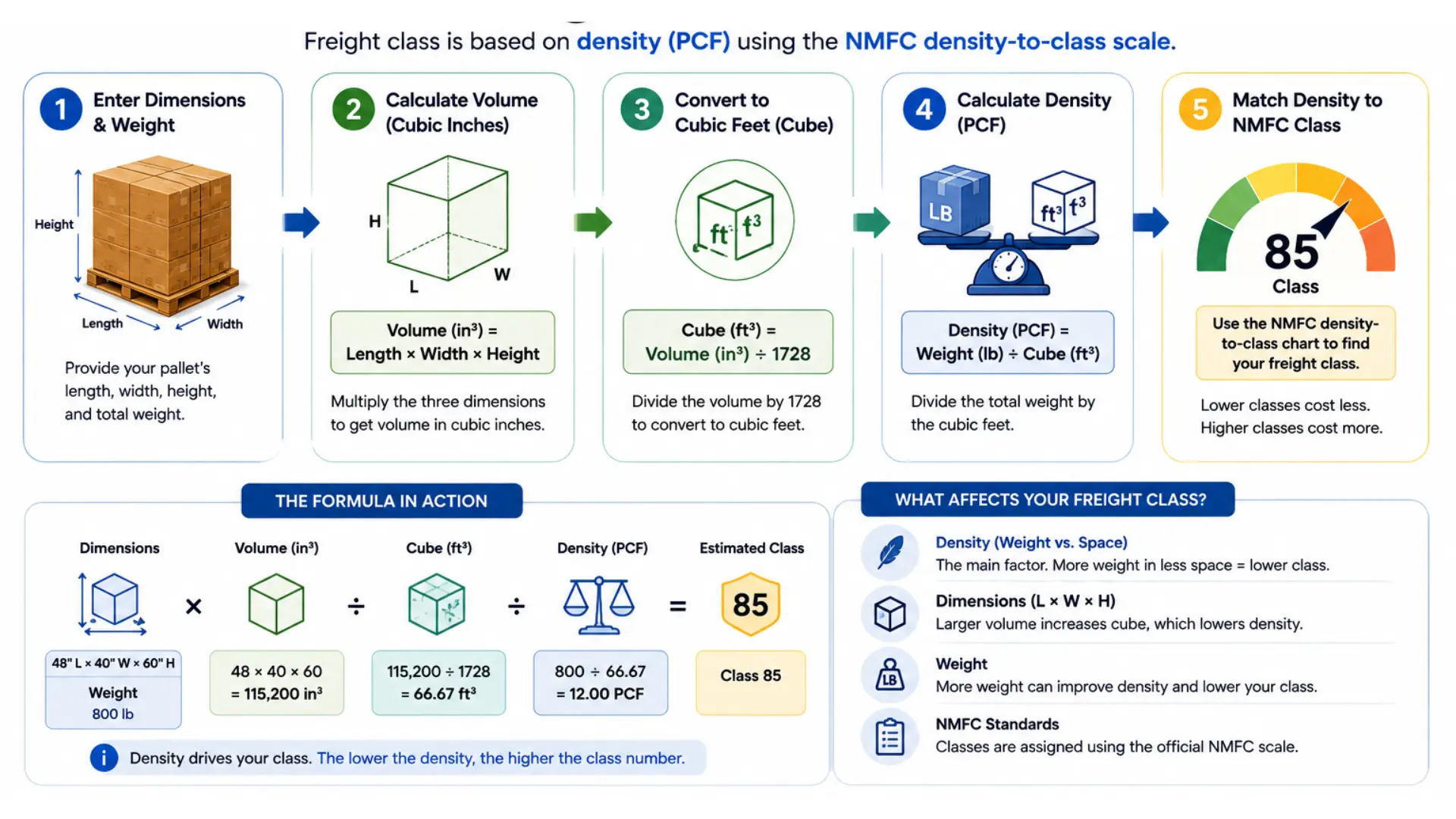
The math is simple, but it’s the same formula that LTL carriers apply during freight classification. First, multiply your pallet’s dimensions to get the volume in cubic inches. Divide that number by 1728 to convert it to cubic feet.
Then divide your weight by the cubic feet to get density in pounds per cubic foot. That density value is matched against the current NMFC density-to-class scale to determine your class.
Your class directly sets your shipping rate. Lower classes cost less per pound to ship; higher classes cost more.
Key Advantages of Using Freight Class Calculator
Instant Results
Enter your dimensions and weight to get your estimated NMFC class instantly. No waiting, no page reloads.
Personalized Ways to Lower Your Cost
See exactly how much weight or height you need to add or remove to drop into a cheaper class. The result is based on your actual shipment, not general advice.
Built on the Current 2026 NMFC Scale
This calculator uses NMFTA’s current 13-tier density scale, not an outdated chart. Your estimate reflects the classification standard carriers are pricing against right now.
Any Unit, One Calculator
Toggle between inches/pounds and centimeters/kilograms. Results always display in standard US units per NMFC convention.
See the Full Breakdown
Get density, cube, and weight alongside your class estimate. Not just a number, so that you can verify the math yourself.
Free, No Sign-Up
It is completely free to use. There is no account creation requirement. Nothing is saved after you close the tab.
How the Freight Class Calculator Works
NMFC Density-to-Class Chart
This table reflects the 13-tier density scale that has been in effect since NMFC restructuring, which added Classes 50 and 55 as new low-density tiers. Shipments dense enough to qualify no longer default to Class 60.
|
Freight Class |
Density Range (PCF) |
Typical Items |
|---|---|---|
|
50 |
50 or more |
Steel, machinery parts, dense hardware |
|
55 |
35 to under 50 |
Dense hardware, bricks |
|
60 |
30 to under 35 |
Dense boxed goods |
|
65 |
22.5 to under 30 |
Auto parts, appliances |
|
70 |
15 to under 22.5 |
Auto parts, drums of liquid |
|
85 |
12 to under 15 |
Appliances, boxed goods |
|
92.5 |
10 to under 12 |
Computers, monitors |
|
100 |
8 to under 10 |
Cabinets, boxed electronics |
|
125 |
6 to under 8 |
Small machines, wine cases |
|
175 |
4 to under 6 |
Auto sheet metal, clothing |
|
250 |
2 to under 4 |
Bulky, low-density furniture |
|
300 |
1 to under 2 |
Very light or fragile goods |
|
400 |
Less than 1 |
Ping pong balls, canoes |
All 18 NMFC Classes for Freight
The NMFC system has 18 classes total: 50, 55, 60, 65, 70, 77.5, 85, 92.5, 100, 110, 125, 150, 175, 200, 250, 300, 400, and 500.
Five of these, 77.5, 110, 150, 200, and 500, are tied to specific commodity listings rather than pure density, so they will not come up from a density calculation alone.
|
Freight Class |
Basis |
Typical Items |
|---|---|---|
|
77.5 |
Named commodity listing |
Specific NMFC items only |
|
110 |
Named commodity listing |
Small machines, wine cases |
|
150 |
Named commodity listing |
Mixed boxed goods, clothing |
|
200 |
Named commodity listing |
Bulky furniture, mattresses |
|
500 |
Named commodity listing |
Very low density, high value goods |
How Is Freight Class Determined?
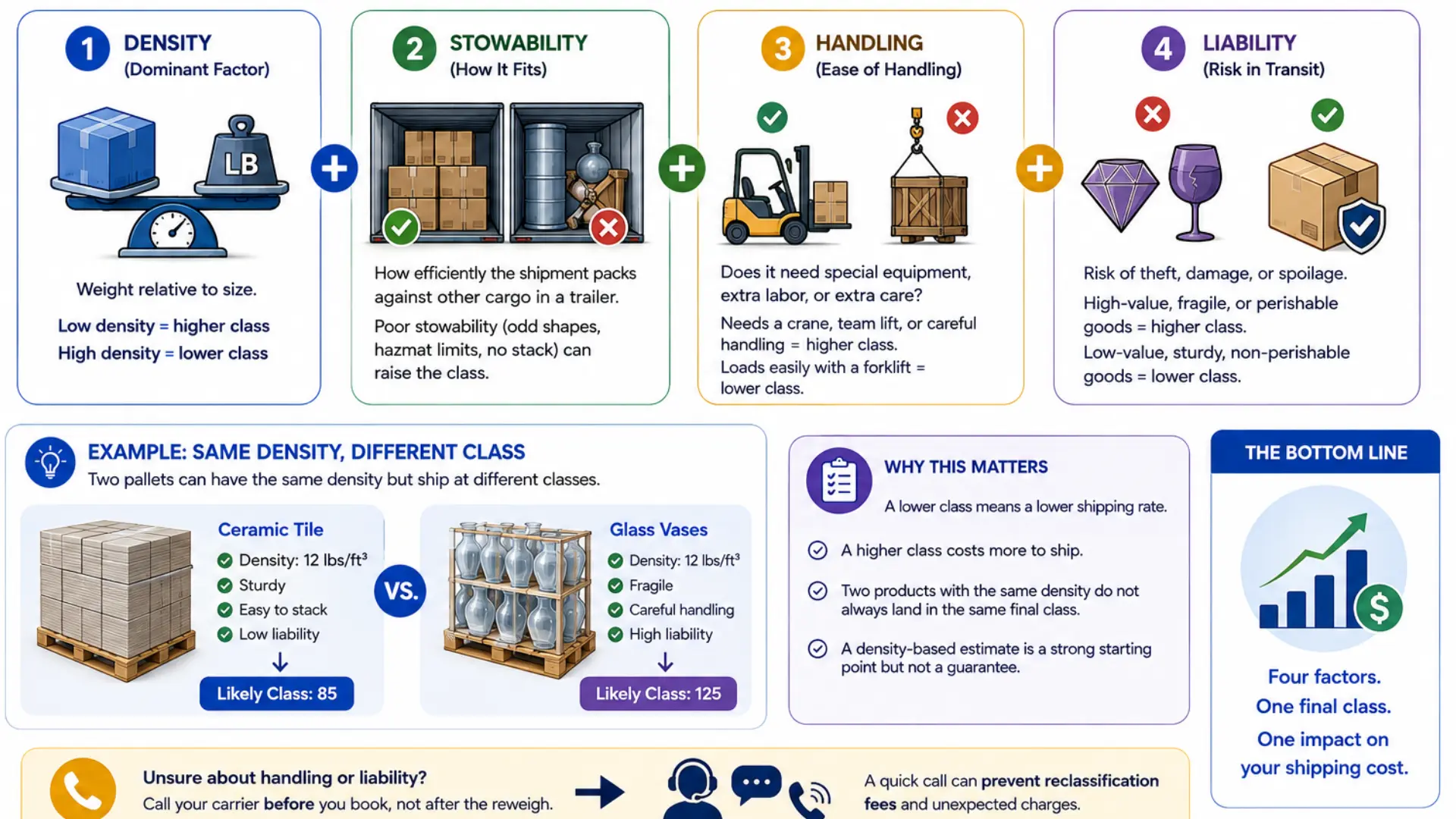
Density is only part of the story. Freight class numbers actually come down to four factors working together, and missing any one of them is how shipments end up reclassified after pickup.
1. Density
Weight relative to size. This is the dominant factor for general freight that our calculator estimates directly. Low density means a higher class. High density means a lower class.
2. Stowability
How efficiently the shipment packs against other cargo in a trailer. Odd shapes, hazmat restrictions, or items that cannot be stacked reduce stowability and can raise the class.
3. Handling
Whether the shipment needs special equipment, extra labor, or extra care to load and unload safely. Freight that needs a crane, team lift, or careful manual handling raises the class. Freight that loads easily with a standard forklift keeps the class lower.
4. Liability
The risk of theft, damage, or spoilage in transit. High-value, fragile, or perishable goods carry elevated liability, which raises the class since the risk of a claim gets priced in. Sturdy, low-value, non-perishable goods carry less liability and stay lower.
A lower class means a lower shipping rate. A higher class costs more to ship. These four factors matter beyond just the number itself. That’s why a density-based estimate is a strong starting point but not a guarantee.
How to Avoid a Reclassification Fee
Carriers reweigh and remeasure freight at the terminal. If your declared class does not match what they find, you get rebilled, and in some cases, freight is held until the charges are resolved.
A reclassification fee runs $50 to $150, plus the rate difference between your declared class and the corrected one. Exact fees vary by carrier, so check your carrier’s tariff for specifics. A reclass from Class 70 to Class 125 can push your freight bill significantly higher.
Five habits prevent most reclass fees:
- Weigh your shipment on a certified scale. Include the pallet’s own weight too.
- Measure the tallest, widest, and longest points of your pallet. If anything hangs over the edge, count that too.
- Round dimensions up, never down.
- Declare your NMFC item number on the bill of lading if you know it.
- Shrink wrap to a uniform footprint. Loose or overhanging freight measures larger than it needs to, which can bump you into a higher class.
Shipments moving through high-volume LTL hubs, such as Chicago, Memphis, Dallas, and the ports of Los Angeles and Long Beach, get inspected more often because of the sheer volume passing through. Measurement errors on these lanes usually get caught quickly.
When Freight Class Doesn’t Apply
LTL (less-than-truckload) shipping covers freight about 150 to 15,000 pounds, sharing trailer space with other shippers. Below that range, small parcel carriers handle it instead. Above it, FTL (full truckload) is the better option, and class of shipment does not apply, since one shipper owns the entire trailer.
NMFC codes apply to domestic U.S. freight only. NMFC class codes apply to domestic U.S. freight only. International shipments use Harmonized Tariff Schedule (HTS) codes instead, a different system built for customs and tariffs, not trailer-space pricing. So a commodity’s NMFC class has no bearing on its international HS code, and vice versa.
FAQs
About This Calculator
Built on the NMFC density scale maintained by the National Motor Freight Traffic Association. This tool estimates class from density alone, while handling, stowability, and liability can raise your final class beyond this estimate. Always confirm your exact class with your carrier before shipping.
Estimate only. Density is the primary factor in most freight class determinations, but handling, stowability, and liability can shift your final class. Confirm your exact class with your carrier before booking, especially for fragile, valuable, or unusual freight. Have any questions about this tool? Contact us.