
The Complete Freight Class Chart – All 18 NMFC Codes & Density Ranges
Shipping something and not sure what it’ll cost? Your freight class decides that. This chart lists all 18 NMFC classes, each one tied to a density range in pounds per cubic foot.
Brokers, warehouse teams, and small shippers use it every day to estimate LTL costs before requesting a quote. The rule is simple: denser shipments get a lower class number and usually cost less to move. Classes run from 50 to 500. Bricks and steel parts sit near class 50, while bulky, lightweight items like foam displays sit near class 500.
Match your shipment’s density to the chart below to find your class, or visit our freight class calculator for an instant result.
A Major NMFC Update Changed This Chart in 2025
On July 19, 2025, NMFC Docket 2025-1 took effect, the largest reclassification in decades. Over 2,000 items moved from commodity-based to density-based classification, and the density scale expanded from 11 to 13 sub-provisions, adding new breaks at 35 and 50 pounds per cubic foot so very dense freight could reach classes 55 and 50. A further round of changes, Docket 2026-1, followed on February 6, 2026.
If you’re working from a chart or saved rate sheet from before mid-2025, it’s outdated. The chart below reflects the current, verified 13-sub scale.
What a Freight Class Chart Actually Tells You
Every piece of LTL cargo needs a class before a carrier can quote a rate or generate a Bill of Lading (BOL). The National Motor Freight Traffic Association (NMFTA) sets these classes based on four factors: density, stowability, handling, and liability. Density carries the most weight in most cases; that’s why the table below is organized by density range first.
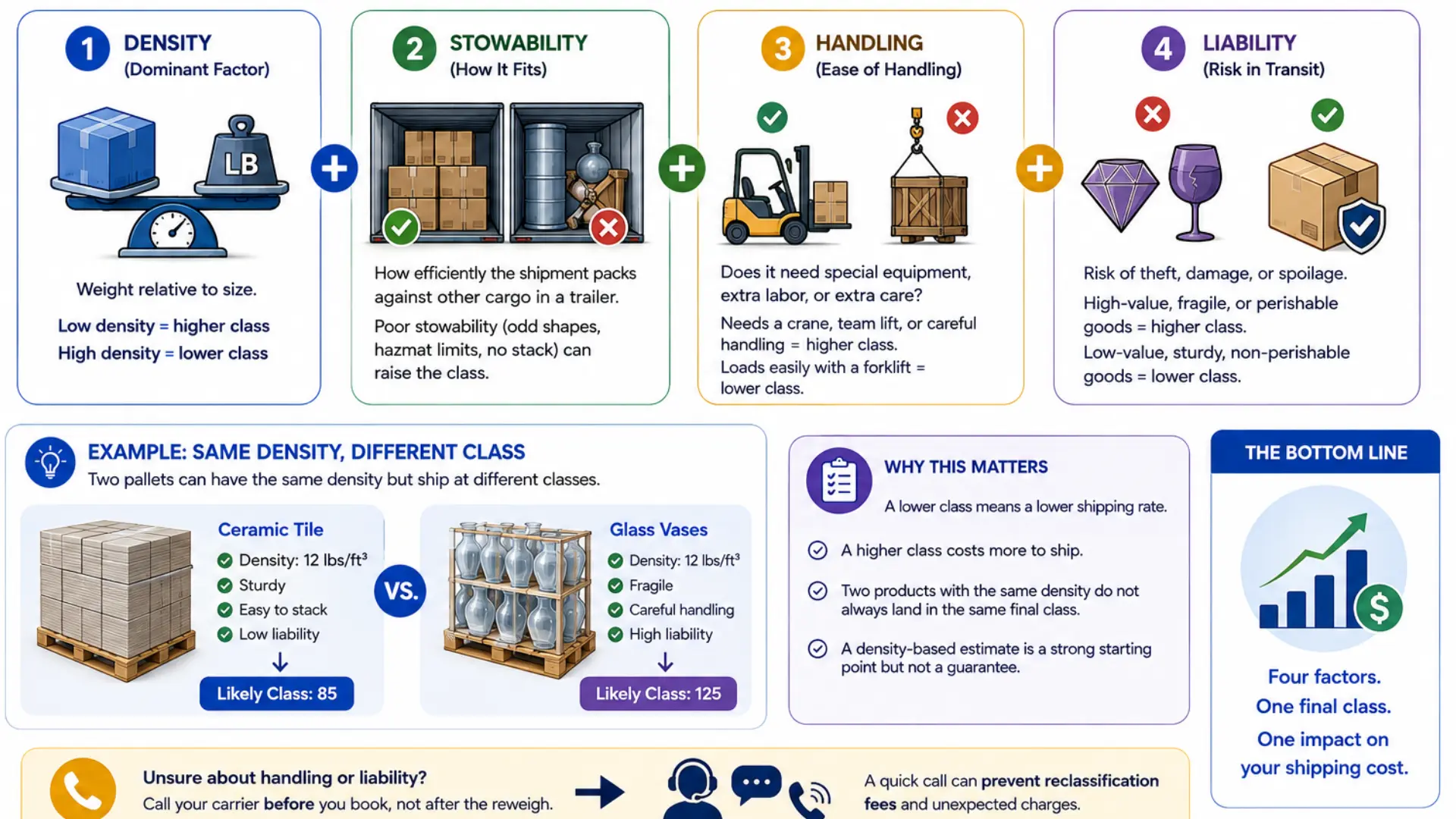
Shippers who skip this step often get hit with a reclassification fee when the carrier inspects the freight. A driver flags a mismatched class on the spot during pickup, and getting the number right before the shipment leaves the dock avoids that cost entirely.
The Density-Based Freight Classes (13 of 18)
These 13 classes are assigned directly from your shipment’s density, weight divided by volume, in pounds per cubic foot (pcf).
|
Class |
Density (lbs per cubic foot) |
Typical Freight |
|---|---|---|
|
50 |
50 or more |
Steel bar stock, bricks, cement, hardware |
|
55 |
35 to under 50 |
Hardwood flooring, bagged mortar |
|
60 |
30 to under 35 |
Car accessories, auto parts, ceramic tile |
|
65 |
22.5 to under 30 |
Bottled drinks, boxed books |
|
70 |
15 to under 22.5 |
Engine parts, packaged food cases |
|
85 |
12 to under 15 |
Crated machinery, cast iron items |
|
92.5 |
10 to under 12 |
Computers, monitors, refrigerators |
|
100 |
8 to under 10 |
Boat covers, wine cases |
|
125 |
6 to under 8 |
Small household appliances, exhibit booths |
|
175 |
4 to under 6 |
Clothing, stuffed furniture |
|
250 |
2 to under 4 |
Bamboo furniture, flat-screen TVs |
|
300 |
1 to under 2 |
Assembled wood furniture, kayaks |
|
400 |
Less than 1 |
Empty drums, foam products |
The Commodity-Listed Classes (5 of 18)
These five classes don’t have a density range. They only apply through a specific NMFC item number tied to handling, stowability, or liability, not measured density. If your commodity falls into one of these, density alone won’t tell you the class; you need the NMFC item number.
|
Class |
Typical Freight |
Why It’s Commodity-Listed |
|---|---|---|
|
77.5 |
Tires, bathroom fixtures |
Handling/liability-based |
|
110 |
Cabinets, framed artwork |
Handling-based |
|
150 |
Bookcases, sheet metal auto parts |
Stowability-based |
|
200 |
Aircraft parts, packaged mattresses |
Handling/stowability-based |
|
500 |
Ping pong balls, gold dust, foam displays |
Liability/value-based |
If your item doesn’t fit neatly into a density band, the specific NMFC number tied to your commodity determines the final class, not density alone.
How Density Is Calculated
Density measures how much weight is packed into a given space: your shipment’s weight divided by its volume. Here’s the formula:
- Measure the length, width, and height of the pallet in inches.
- Multiply the three numbers to get cubic inches.
- Divide cubic inches by 1,728 to get cubic feet.
- Divide the total weight in pounds by the cubic feet.
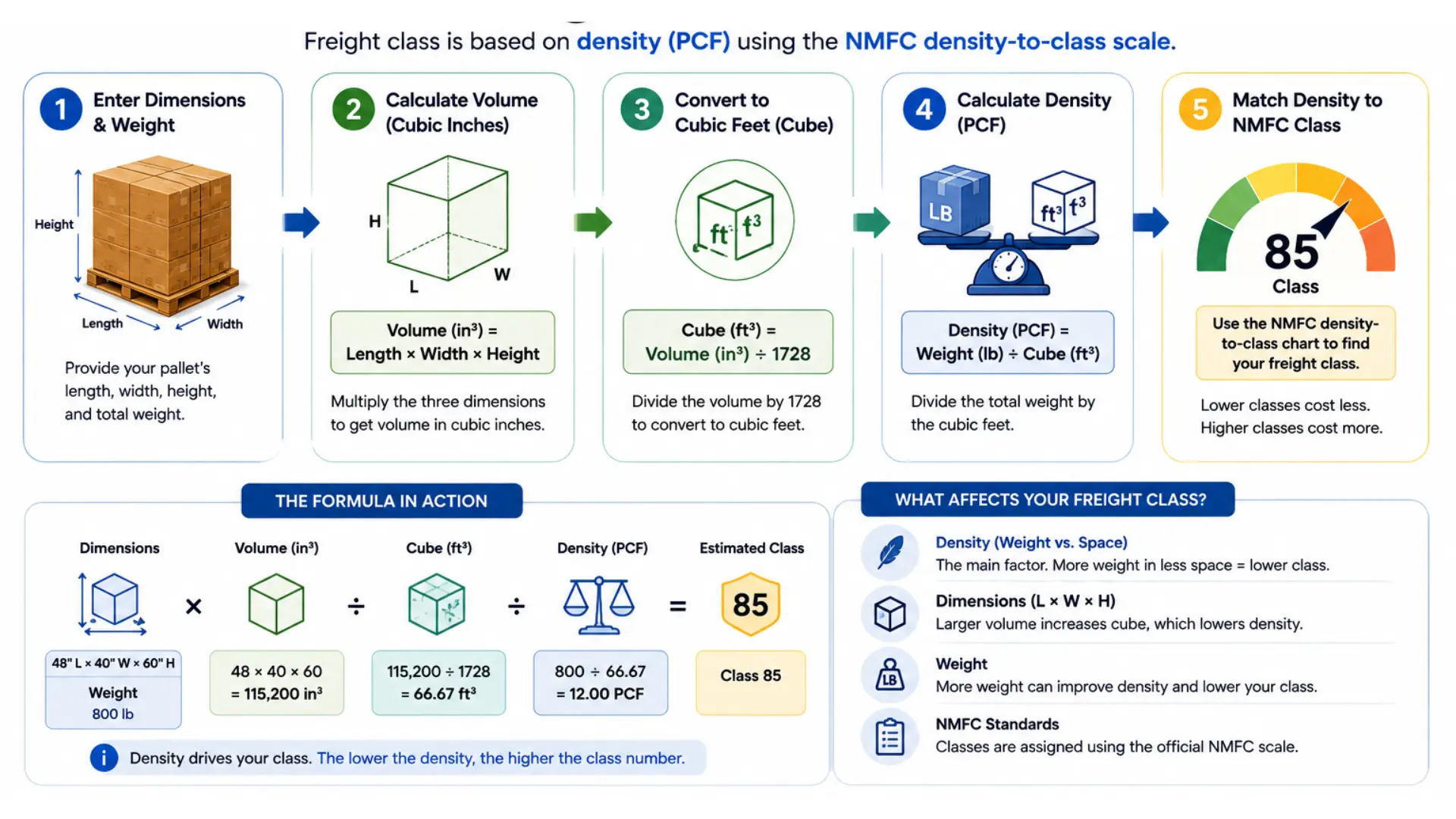
Skip the manual math. Our freight class density calculator takes your dimensions and weight and gives you the exact class, so a rounding error doesn’t turn into a reclassification fee.
How LTL Shipments Affect the Class
LTL shipments often combine multiple items on one pallet, and that changes how class applies. Say a pallet holds car accessories at class 60 and car covers at class 100. The entire pallet gets billed at class 100, the highest class present. Carriers don’t average the classes together, so one high-class item can raise the cost of everything else sharing that pallet.
NMFC Codes vs Freight Class
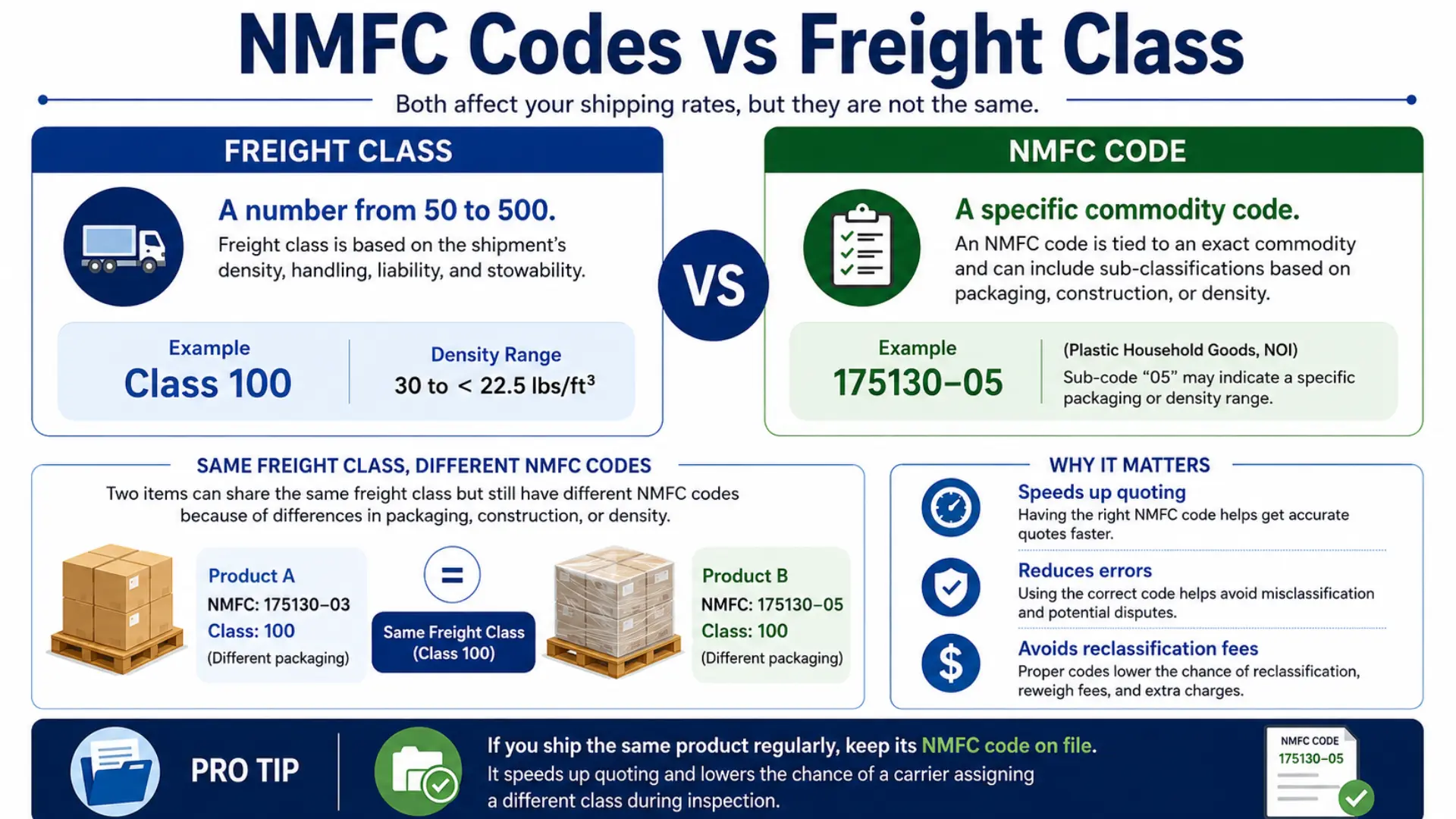
A freight class is a number from 50 to 500. An NMFC code is more specific. It’s tied to an exact commodity, sometimes with sub-classifications based on packaging or density. So two items can share the same class but still carry different NMFC codes, depending on how they’re packaged or crated.
If you ship the same product regularly, keep its NMFC code on file. It speeds up quoting and lowers the chance of a carrier assigning a different class during inspection.
How Classification Mistakes Cost You Money
Misclassifying freight is one of the most common mistakes new shippers make. If the declared class doesn’t match the actual density or commodity, they reclassify it and rebill the shipper, usually at a higher rate.
By the time you find out, the shipment has already moved. Disputing a reclassification after the fact is slow, and it rarely works unless you have documentation to back you up.
The safest approach:
- Weigh and measure your cargo accurately before booking
- Keep photos of the freight and packaging
- Confirm the class using the current chart or calculator instead of an old printout or a rough guess
FAQs
This chart reflects current NMFC density classification standards as of 2026. For questions about a specific commodity’s official classification, contact the National Motor Freight Traffic Association directly.