Parcel vs LTL in 2026: Where Is the Break-Even Point Now?
In 2026, the parcel-to-LTL break-even point sits around 150 to 200 pounds for commercial shipments. Three changes moved it this year: USPS cut its dimensional weight divisor from 166 to 139 on July 12, holiday parcel surcharges rose as much as 23 percent, and NMFC density rules reshaped LTL pricing. Above 150 pounds, LTL typically costs 30 to 65 percent less per pound than parcel.
What Does Break-Even Mean in Shipping?
Break-even is the weight where parcel stops being the cheaper option and LTL takes over. Below it, parcel carriers like UPS, FedEx, and USPS win. Above it, pallets on an LTL carrier win.
The exact point moves with fuel surcharges, dimensional weight rules, and freight class. In 2026, all three moved at once.
Parcel vs LTL at a Glance
| Factor | Parcel | LTL |
|---|---|---|
| Best weight range | Under 150 pounds | Over 200 pounds |
| Max package weight | 150 pounds | Up to 15,000 pounds per shipment |
| How it ships | Individual boxes | Palletized freight |
| Holiday surcharges 2026 | Up to $0.90 per package | None per package |
| Speed | 1 to 5 days typical | 2 to 6 days typical |
| Cost above 150 pounds | Higher per pound | 30 to 65 percent less per pound |
The Three 2026 Changes That Moved the Line
| Date | Change | Effect |
|---|---|---|
| January 2026 | Annual general rate increases from UPS, FedEx, and USPS | Parcel base rates rose across the board |
| April 26, 2026 | USPS added an 8 percent transportation surcharge | Stacked on top of base rates through January 2027 |
| July 12, 2026 | USPS cut its dimensional weight divisor from 166 to 139 | Billable weight on bulky parcels rose about 19 percent |
| Sept to Oct 2026 | Holiday demand surcharges took effect at all major parcel carriers | Up to 23 percent higher than 2025 peak surcharges |
| December 12, 2026 | NMFC Supplement 2026-2 takes effect | More commodities move to density based LTL classification |
Change 1: The USPS Dimensional Weight Shock
Dimensional weight, or DIM weight, is the billable weight carriers assign based on box size instead of actual weight. The formula is length times width times height in inches, divided by a divisor. A smaller divisor means a higher billable weight.
On July 12, 2026, USPS cut its divisor from 166 to 139 for Priority Mail Express, Priority Mail, Ground Advantage, and Parcel Select on packages over one cubic foot.
Take an 18 by 14 by 10 inch box, which is 2,520 cubic inches. Before July 12, the math was 2,520 divided by 166, which is 15.2, rounded up to 16 billable pounds. After July 12, it is 2,520 divided by 139, which is 18.1, rounded up to 19 billable pounds.
Same box, same contents, 3 more billable pounds.
That one change made parcel roughly 19 percent more expensive for bulky lightweight boxes overnight. Every box like that sitting near the old break-even point tipped toward LTL.
Change 2: Holiday Surcharges Push Parcel Higher
Parcel carriers add demand surcharges every fourth quarter. In 2026 they are the highest yet. UPS charges up to $0.75 per residential package from November 22 to December 26.
FedEx charges up to $0.80 from November 23 to December 27.
DHL eCommerce peaks at $0.90. USPS runs its holiday pricing from October 4, 2026 to January 17, 2027.
Large package surcharges hurt more. UPS charges $117.50 per large package during peak weeks. FedEx charges $117.25 for oversize.
Ship 20 large boxes in December and surcharges alone add more than $2,300. Those same 20 boxes on two pallets via LTL dodge every one of those per package fees.
Change 3: NMFC Density Rules Reshaped LTL
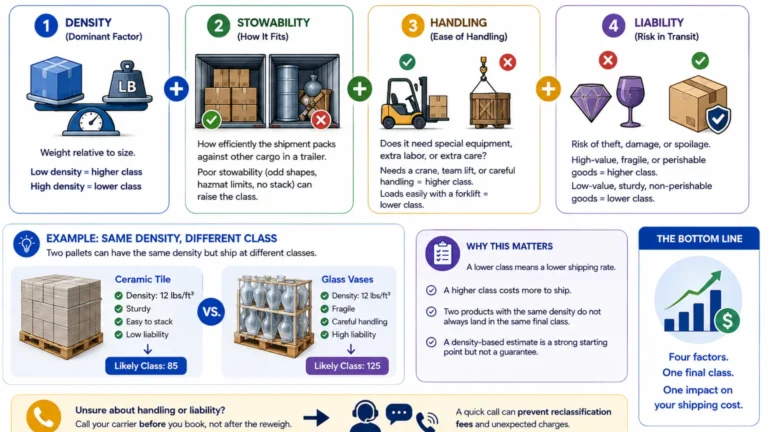
On the LTL side, the 2025 NMFC overhaul moved more than 2,000 commodities to density based classification on a 13 tier scale. Dense freight often dropped to a lower class and a better rate. Light, bulky freight often rose.
With Supplement 2026-2 effective December 12, 2026, more commodities join the density scale. What this means for the break-even math: if your product is dense, LTL got cheaper relative to parcel and the break-even point moved down.
If your product is light and bulky, LTL got more expensive and the point moved up. There is no single new number. You have to run your own density.
Where Is the Break-Even Point Now?
For commercial business to business shipments, the crossover sits at roughly 150 to 200 pounds. Below 150 pounds, parcel almost always wins. Above 200 pounds, LTL almost always wins.
Between 150 and 200, it depends on density, distance, and accessorials.
Above 150 pounds, LTL typically costs 30 to 65 percent less per pound than parcel, according to rate data published by Warp. The savings grow with weight.
A 500 pound palletized shipment at Class 70 can run about $426 all in on a 500 mile lane. The same weight split across parcel boxes costs far more once DIM weight and surcharges apply.
Parcel also has hard limits. No parcel carrier takes a single package over 150 pounds. Maximum length is 108 inches, and length plus girth cannot exceed 165 inches.
Anything bigger must go LTL or full truckload regardless of price.
Worked Example: The Same Shipment Before and After July 12
A small business in Columbus, Ohio ships four boxes of trade show displays to a convention center in Chicago. Each box is 24 by 18 by 18 inches and weighs 35 pounds. Total actual weight is 140 pounds.
Each box is 7,776 cubic inches. Before July 12, 2026, USPS DIM math was 7,776 divided by 166, which is 46.8, rounded to 47 billable pounds per box. Four boxes meant 188 billable pounds.
After July 12, the math is 7,776 divided by 139, which is 55.9, rounded to 56 billable pounds per box. Four boxes now bill at 224 pounds, a 19 percent jump with zero change in the actual freight.
At 224 billable pounds, this shipment sits above the break-even point. Palletized as one 140 pound handling unit and shipped LTL, it would likely cost 30 to 50 percent less than parcel, and it avoids the per package holiday surcharges entirely. Before July 12, the same shipment was a closer call.
That is the break-even shift in one real example.
Simple Decision Framework
Use parcel when: the shipment is under 150 pounds total, boxes are small and dense, the destination is residential, or speed matters more than cost.
Use LTL when: the shipment is over 200 pounds, you can palletize, the freight is dense, you ship to commercial addresses with docks, or per package surcharges are eating your margin.
Check both when: the shipment is 150 to 200 pounds. Run the density with our free freight class calculator, get an LTL quote, and compare it against parcel with all surcharges included. Most shippers in this zone who bother to check find LTL wins.
Consider full truckload when: your LTL shipments consistently exceed 6 or 7 pallets. At that point, one dedicated trailer often beats multiple LTL rates.
Frequently Asked Questions
At what weight should I switch from parcel to LTL?
Around 150 to 200 pounds for commercial shipments. Below 150 pounds parcel usually wins, above 200 pounds LTL usually wins, and the 150 to 200 zone deserves a direct quote comparison.
What is dimensional weight and why did it change in 2026?
Dimensional weight is billable weight based on box size rather than actual weight. USPS cut its DIM divisor from 166 to 139 on July 12, 2026, which raised billable weight about 19 percent on affected parcels over one cubic foot.
Do holiday surcharges apply to LTL?
LTL carriers do not charge per package holiday surcharges the way parcel carriers do. That is one reason peak season shifts the break-even point toward LTL. LTL rates still rise with demand and fuel, but there is no $0.80 per package fee.
How does freight class affect the break-even point?
Freight class sets your LTL rate. Dense freight at a low class makes LTL cheap and pushes break-even down. Light bulky freight at a high class makes LTL expensive and pushes break-even up.
Calculate density first with our freight class chart, then compare.
Can I ship a pallet via UPS or FedEx parcel?
No. Parcel networks cap single packages at 150 pounds and 108 inches long. A palletized shipment must go LTL, full truckload, or a carrier that handles palletized freight.
Sources
- Warp, LTL vs Parcel Shipping in 2026 (updated September 30, 2026) – wearewarp.com
- DeBales, The Parcel to LTL Break Even Moved (September 1, 2026) – debales.ai
- GoShippo, UPS, FedEx, USPS and DHL holiday surcharges for 2026 (updated October 2026) – goshippo.com
- UniShippers, Parcel vs LTL Freight: When to Make the Switch – unishippers.com
- Mail Station, USPS Dimensional Weight Divisor Change 2026 (August 30, 2026) – mailstationmonroe.com