
NMFC Docket 2026-2: What Changes on December 12, 2026 (and What Does Not)
NMFC Docket 2026-2 takes effect on December 12, 2026. It moves more commodities to density based freight classification. The proposed rewrite of Item 640, the mixed freight rule, did not pass, so mixed shipment rules stay as they are.
Shippers should audit their freight classes before the effective date to avoid reclassification fees.
What Is NMFC Docket 2026-2?
NMFC Docket 2026-2 is a package of proposed changes to the National Motor Freight Classification system. NMFTA, the National Motor Freight Traffic Association, issued it on August 28, 2026.
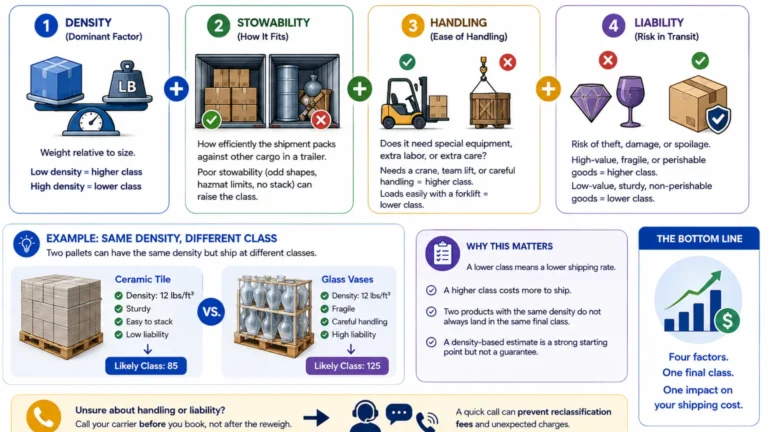
It contains about 33 proposed changes. Most of them move more commodities to full density based classification. That means the freight class of those goods will depend on density alone, not on what the product is.
This docket is the second wave of a larger project called Classification Reimagined. The first wave, Docket 2025-1, took effect on July 19, 2025. It moved more than 2,000 commodities to density based classification and expanded the density scale from 11 tiers to 13 tiers, adding Class 50 and Class 55.
Key Dates for Docket 2026-2
| Date | What Happened |
|---|---|
| August 28, 2026 | NMFTA issued Docket 2026-2 with about 33 proposed changes |
| September 23, 2026 | Public comment period closed |
| September 29, 2026 | Freight Classification Development Center held a public meeting |
| October 9, 2026 | NMFTA issued the disposition bulletin with final decisions |
| November 12, 2026 | Supplement 2026-2 issued |
| December 12, 2026 | Supplement 2026-2 takes effect |
| January 24, 2027 | NMFC Book 2027 takes effect |
What Passed and What Did Not
| Proposal | Outcome |
|---|---|
| More items moved to full density scale | Passed. A significant number of items approved, per NMFTA. |
| Item 640 mixed freight rewrite | Did not pass. Old mixed freight rules stay in place. |
| Ladders, shades, and blinds to full density | Pulled back. Handling concerns kept them out for now. |
| Item 680 packaging changes | Disapproved, per the disposition bulletin. |
How the New Density Scale Works
NMFTA approved a significant number of items moving to the full density scale. In plain terms, more products lost their old commodity specific classes. Their freight class now comes from a simple density table.
Density is weight in pounds divided by cubic feet. Here is the 13 band scale:
| Density (pounds per cubic foot) | Freight Class |
|---|---|
| Less than 1 | 400 |
| 1 to 2 | 300 |
| 2 to 4 | 250 |
| 4 to 6 | 175 |
| 6 to 8 | 125 |
| 8 to 10 | 100 |
| 10 to 12 | 92.5 |
| 12 to 15 | 85 |
| 15 to 22.5 | 70 |
| 22.5 to 30 | 65 |
| 30 to 35 | 60 |
| 35 to 50 | 55 |
| 50 or more | 50 |
Not every proposal survived. NMFTA pulled some items back after industry feedback. Ladders and shades or blinds are two examples.
They are long and awkward to handle, so they will not move to full density at this time.
The Item 640 Rewrite Did Not Pass
Many articles still describe the Item 640 rewrite as a pending proposal. It is not pending. It failed.
NMFTA confirmed this in its October 9, 2026 disposition bulletin.
Item 640 is the rule for mixed freight. It covers a shipment with several different articles, like a pallet holding boxes of different products at different classes. The proposed rewrite would have changed how those pallets get classified.
Under the proposal, the bill of lading would list each article separately. The handling unit would then be classified using the 13 band density scale. That idea did not get enough support to pass.
The old mixed freight rules stay in place. If you ship mixed pallets, nothing changes for you on December 12 from Item 640.
How Does This Affect Your Shipping Costs?
If your products moved to full density classification, your freight class may have changed. A change in class changes your rate.
Research cited by MyCarrier puts the average program level rate impact at 2 to 3 percent in either direction. But the spread is wide. Lightweight, bulky shipments that used to get a favorable class can now see rate increases of 20 to 35 percent.
Dense freight sometimes moves to a lower class and gets a better rate.
About 15 percent of LTL shipments face reclassification today, according to the same research. When a carrier inspects your freight and finds the wrong class, you pay the corrected rate plus a reclassification fee.
The real cost is the rate change itself. Shippers often see invoices 20 to 50 percent higher than the original quote after an upward reclassification.
What Shippers Should Do Before December 12, 2026
- List your most shipped commodities. Start with the 10 products you ship most often.
- Measure real density as palletized. Weigh the pallet as it actually ships, stretch wrap and all. Measure length, width, and height in inches. Divide cubic inches by 1,728 to get cubic feet. Then divide weight by cubic feet.
- Check the class against the new scale. Use the 13 band table above or our freight class calculator to confirm each product still sits in the right class.
- Update your item master and bills of lading. If a class changed, update your TMS, your rate tables, and the class printed on every BOL.
- Flag mixed pallets. Since Item 640 did not change, keep classifying mixed shipments exactly as you do today.
- Talk to your carrier or 3PL now. Ask which of your NMFC items moved to full density in Supplement 2026-2. Do this before peak season volume hits.
Worked Example: How Density Decides the Class
A shipper in Atlanta sends a standard 48 by 40 inch pallet of boxed paper towels to a customer in Charlotte. The pallet weighs 980 pounds including the pallet itself. It measures 48 by 40 by 54 inches tall.
First, find cubic inches: 48 x 40 x 54 = 103,680. Divide by 1,728 to get cubic feet: 60.
Then divide weight by cubic feet: 980 / 60 = 16.3 pounds per cubic foot. On the 13 band scale, 15 to 22.5 maps to Class 70. So this pallet ships as Class 70.
If the old commodity listing gave those paper towels Class 85, the move to density just lowered the class and the rate. If it gave Class 55, the rate just went up. That is why measuring matters more than memory.
Frequently Asked Questions
When does NMFC Docket 2026-2 take effect?
December 12, 2026. That is when Supplement 2026-2 becomes effective, according to NMFTA. The NMFC Book 2027 follows on January 24, 2027.
Did the Item 640 mixed freight rewrite pass?
No. NMFTA confirmed in its October 9, 2026 disposition bulletin that the rewrite of Rule 640 did not pass. Mixed freight classification rules are unchanged.
Which commodities moved to density based classification?
NMFTA approved a significant number of items moving to the full density scale but has not published a simple consumer list. Check the official Disposition Bulletin or ask your carrier which of your NMFC items changed.
How much can reclassification cost me?
You pay the corrected, usually higher rate plus a reclassification fee. Research cited by MyCarrier shows quote to invoice variance of 20 to 30 percent tied to reweighs and reclassifications.
Where can I verify my freight class?
Use the NMFTA ClassIT tool for official NMFC lookups, or use our free freight class calculator to estimate class from weight and dimensions before you book.
Sources
- NMFTA, 2026-2 Disposition Bulletin: Density and NMFC Insights (October 9, 2026) – nmfta.org
- FleetOwner, NMFC Docket 2026-2 proposes changes to mixed freight classification rules (September 23, 2026) – fleetowner.com
- MyCarrier, NMFC Class Changes 2026: What LTL Shippers Should Know (September 22, 2026) – go.mycarrier.io
- Optioryx, How to calculate freight class in 2026 (October 13, 2026) – optioryx.com
- GlobalTranz, 9 Freight Peak Season Challenges for 2026 (October 15, 2026) – globaltranz.com
2 Comments