
What Is Freight Class?
What Is Freight Class?
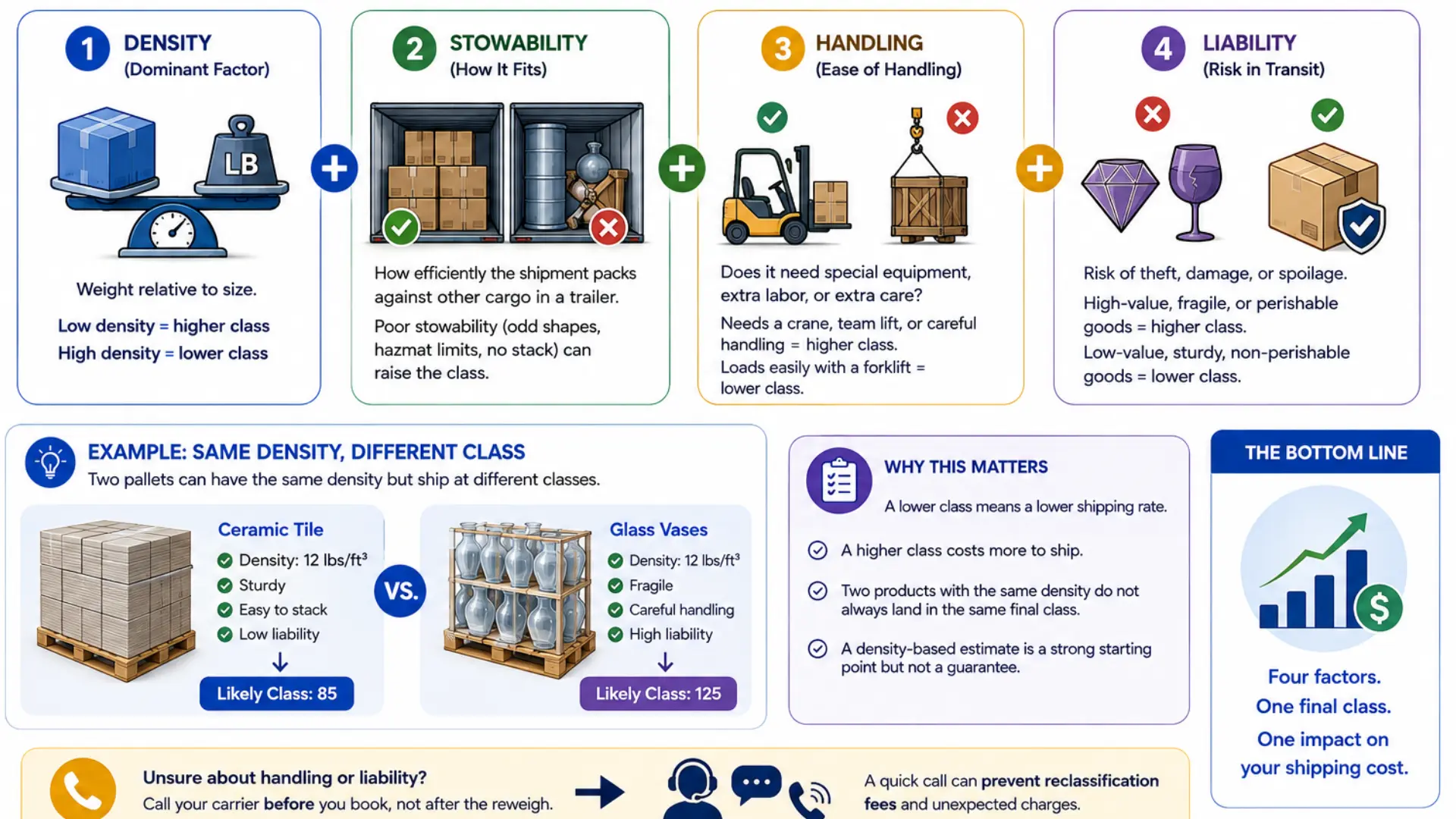
Freight class is a standardized classification from Class 50 to Class 500 used to classify LTL freight based on its transportation characteristics. The system considers four main factors: density, handling, stowability, and liability. In general, lower freight classes represent freight that is easier to transport, while higher classes represent freight with greater transportation challenges.
The National Motor Freight Traffic Association (NMFTA) publishes and maintains the National Motor Freight Classification (NMFC), which provides the classification standards used for many LTL shipments. Your freight class can affect the rate a carrier applies to your shipment, so using the correct classification is important when preparing an LTL shipment.
If the class on your shipping documents does not match the classification the carrier determines after inspecting the freight, the carrier may reclassify the shipment and adjust the charges.
What Does Freight Class Mean in Shipping?
Freight class is a way to group LTL freight according to how difficult it is to transport. LTL, or less-than-truckload shipping, is used when a shipment does not require an entire trailer. Multiple customers’ shipments can share space on the same truck.
Freight class helps carriers account for characteristics that can affect the cost and handling of freight. A dense, easy-to-stack shipment may be easier to transport than a large, fragile, or difficult-to-handle shipment of the same weight.
Freight class is primarily associated with LTL trucking. It should not be confused with LCL, or less-than-container-load shipping, which is an ocean freight term.
What Are the Freight Classes?
The standard freight class range runs from Class 50 through Class 500. There are 18 standard classes within this range:
50, 55, 60, 65, 70, 77.5, 85, 92.5, 100, 110, 125, 150, 175, 200, 250, 300, 400, and 500.
A lower number generally represents freight with favorable transportation characteristics, while a higher number generally represents freight that takes more space, requires more handling, is harder to stow, or carries greater liability.
The exact class for a commodity cannot always be determined from density alone. The applicable NMFC item and the freight’s transportation characteristics also matter.
How Is Freight Class Determined?
Freight class is determined by the applicable NMFC classification and the transportation characteristics of the commodity. NMFTA identifies four major characteristics used in freight classification:
1. Density
Density is the weight of the freight compared with the amount of space it occupies. It is usually expressed in pounds per cubic foot (PCF).
To calculate density:
Density = Weight ÷ Cubic Feet
For a rectangular shipment, calculate cubic feet first:
Cubic Feet = Length × Width × Height ÷ 1,728
Use the shipment’s actual dimensions and weight, including the packaging that will travel with the freight.
Density is especially important for commodities that are classified under the current density-based structure.
2. Handling
Handling considers how easy or difficult the freight is to move during transportation.
Freight that requires special care, unusual loading procedures, or additional handling may have characteristics that affect its classification.
3. Stowability
Stowability refers to how easily freight can be positioned with other shipments in a trailer.
Freight with an unusual shape, poor stackability, or other characteristics that make efficient use of trailer space difficult can present greater stowability challenges.
4. Liability
Liability considers the potential for loss, damage, theft, or other risks associated with transporting the commodity.
A commodity that is fragile, susceptible to damage, or otherwise presents greater transportation risk may have different classification considerations from durable freight.
These four characteristics work together. Density is important, but freight class is not simply a universal density-to-class calculation for every commodity.
What Is NMFC Freight Class?
NMFC freight class refers to the freight classification assigned under the National Motor Freight Classification.
It is important to distinguish between an NMFC item number and a freight class.
An NMFC item number identifies a specific commodity or group of commodities in the NMFC. The applicable classification provision then determines the freight class or classes that apply.
For example, a commodity may have a specific NMFC item with classifications that vary by density. Another commodity may have a classification provision that does not use the same density-based approach.
This is why simply searching for a product name or calculating density may not always be enough to determine the final classification.
Freight Class vs. NMFC Code
Freight class and NMFC code are related, but they are not the same thing.
| Freight Class | NMFC Item Number |
|---|---|
| A classification from 50 to 500 | Identifies a commodity or commodity group |
| Helps determine the applicable LTL classification | Helps identify the applicable classification provision |
| Can be density-based for applicable commodities | Specifies the commodity and classification rules |
| Examples include Class 50, 85, 100, and 250 | Each commodity has its own applicable NMFC item number |
Think of the NMFC item number as the commodity identifier and the freight class as the classification level that applies under the relevant NMFC provision.
The 2025–2026 NMFC Changes
The NMFC underwent major classification changes beginning in 2025.
Changes from NMFC Docket 2025-1 became effective July 19, 2025. One of the major changes was the move from the previous 11-tier density scale to a new 13-tier density-based structure for applicable commodities. The changes also modified a large number of commodity listings and moved more freight toward density-based classification where appropriate.
The important point for shippers is that the current classification rules may not match older freight-class charts or calculators based on the pre-2025 system.
The overall freight class range remains Class 50 through Class 500, but the density breaks used for applicable commodities changed.
Because NMFC updates can affect individual commodities differently, shippers should use current NMFC information when determining the classification for an actual shipment.
Important: Do not assume that an older freight class chart is still correct simply because it appears on another website.
What Is the Current NMFC Density Scale?
For applicable density-based commodities, the current 13-tier structure uses these density breaks:
| Density (lb/ft³) | Freight Class |
|---|---|
| 50 or greater | 50 |
| 35 to less than 50 | 55 |
| 30 to less than 35 | 60 |
| 22.5 to less than 30 | 65 |
| 15 to less than 22.5 | 70 |
| 12 to less than 15 | 85 |
| 10 to less than 12 | 92.5 |
| 8 to less than 10 | 100 |
| 6 to less than 8 | 125 |
| 4 to less than 6 | 175 |
| 2 to less than 4 | 250 |
| 1 to less than 2 | 300 |
| Less than 1 | 400 |
Note: This density table applies to commodities that are classified under the applicable density-based structure. It does not mean every commodity can be assigned a freight class from density alone.
If you want to see the complete classification information in an easier format, visit our freight class chart.
How to Calculate Freight Density
Calculating density is simple when your shipment is rectangular.
Step 1: Measure the shipment
Measure the:
- Length
- Width
- Height
Use inches and measure the shipment as it will actually be presented to the carrier, including packaging and any relevant overhang.
Step 2: Calculate cubic feet
Multiply the three dimensions:
Length × Width × Height
Then divide by 1,728:
Cubic Feet = Length × Width × Height ÷ 1,728
Step 3: Calculate density
Divide the total shipment weight by the cubic feet:
Density = Weight ÷ Cubic Feet
Example
Suppose a pallet measures:
- Length: 48 inches
- Width: 40 inches
- Height: 48 inches
- Weight: 500 pounds
First calculate cubic feet:
48 × 40 × 48 ÷ 1,728 = 53.33 cubic feet
Then calculate density:
500 ÷ 53.33 = 9.38 lb/ft³
Under the current density table, 9.38 lb/ft³ falls within the 8 to less than 10 lb/ft³ range, which corresponds to Class 100 for applicable density-based commodities.
This is a density-based estimate. The final classification still depends on the applicable NMFC provision.
How to Find Your Freight Class
There are several steps you can take to find the correct freight class.
1. Identify the commodity
Start with the actual product or commodity being shipped. The applicable NMFC item may depend on the commodity, its description, packaging, and other characteristics.
2. Check the applicable NMFC item
If the commodity has a specific NMFC classification provision, use that provision rather than assuming that density alone determines the class.
3. Measure the shipment
Record the actual:
- Length
- Width
- Height
- Weight
Accurate measurements are important because incorrect dimensions can produce an incorrect density.
4. Calculate density when applicable
Use the dimensions and weight to calculate pounds per cubic foot.
5. Check the current density range
If the commodity is classified using the applicable density-based structure, compare the calculated density with the current NMFC density breaks.
6. Consider the other classification factors
Check whether handling, stowability, or liability characteristics affect the applicable classification.
For an easier density calculation, you can use our free freight class calculator to calculate cubic feet, density, and an estimated freight class.
What Is a Freight Class Calculator?
A freight class calculator is an online tool that calculates shipment density from the dimensions and weight you enter. It can then use the applicable density ranges to provide an estimated freight class for shipments that fall under the density-based classification structure.
For example, if your pallet measures 48 × 40 × 48 inches and weighs 500 pounds, the calculator can determine:
- Cubic feet
- Density in lb/ft³
- Estimated freight class
A calculator saves you from doing the formula manually.
However, a calculator should not be treated as a substitute for the applicable NMFC classification. Some commodities have specific classification provisions, and the final class may depend on more than density.
Why Does Freight Class Matter?
Freight class can affect the rate applied to an LTL shipment.
In general, a higher freight class can result in a higher transportation rate than a lower class, although the actual price depends on many factors beyond class.
These can include:
- Origin
- Destination
- Carrier
- Shipment weight
- Freight class
- Freight characteristics
- Discounts or negotiated rates
- Fuel charges
- Accessorial services
- Minimum charges
- Other carrier pricing rules
This means you should not assume that changing the class by one level will always produce a fixed percentage change in your shipping cost.
What Happens If You Use the Wrong Freight Class?
If the freight class declared on your shipping documents does not match the classification determined by the carrier, the shipment may be reclassified.
A carrier may inspect the freight and compare its:
- Weight
- Dimensions
- Packaging
- Commodity description
- NMFC classification
- Other relevant characteristics
If the carrier determines that a different classification applies, the charges can be adjusted.
The result may be an additional amount due, depending on the difference between the original and corrected charges and the carrier’s applicable pricing rules.
How to Reduce Classification Problems
You can reduce the risk of reclassification by:
- Measuring the shipment accurately.
- Weighing the complete shipment.
- Including packaging in your measurements.
- Describing the commodity correctly.
- Using the current NMFC information.
- Checking whether the commodity has a specific NMFC provision.
- Keeping your measurement and shipping records.
If you receive a reclassification charge, check the carrier’s inspection information and compare it with your bill of lading, shipment measurements, and other records. Follow the carrier’s published process and deadline for disputing the charge.
Does Freight Class Apply to Every Type of Freight?
No, Freight class is primarily associated with LTL freight classification. Other transportation modes use different pricing and classification systems.
For example:
- LTL: Freight class is commonly part of the rating process.
- FTL: Full truckload shipments generally use different pricing considerations.
- LCL: Less-than-container-load ocean shipping uses a different system from LTL freight classification.
- Parcel: Small-package carriers use their own pricing structures.
The transportation mode matters when determining which classification and pricing rules apply.
Freight Class vs. LTL Freight Rate
Freight class and the final LTL rate are not the same thing.
Freight class describes the classification of the freight. LTL rate is the amount charged to transport the shipment under the carrier’s applicable pricing rules.
The freight class can influence the rate, but it is only one part of the overall pricing calculation.
Two shipments with the same freight class can still receive different quotes because they may have different origins, destinations, weights, carrier discounts, fuel charges, accessorial requirements, or other pricing factors.
Frequently Asked Questions
1. Can two shipments of the same product have different freight classes?
Yes. Two shipments of the same product can have different classifications when their dimensions, weight, packaging, or other transportation characteristics differ. For density-based freight, changing the shipment’s weight or the space it occupies can change its density and potentially its applicable class.
2. Does packaging affect freight class?
Yes. Packaging can affect the shipment’s overall dimensions, weight, handling, stowability, and liability. When calculating density, use the measurements and weight of the freight as it will actually be presented to the carrier.
3. Does pallet size affect freight class?
It can. A larger pallet footprint or greater height increases the amount of space the shipment occupies. If the weight stays the same, using more cubic feet lowers the shipment’s density, which can affect the applicable density-based class.
4. Can adding weight lower freight class?
For density-based freight, adding weight without increasing the shipment’s dimensions increases density. A higher density can move the shipment into a lower class range. However, you should never add unnecessary weight just to change a classification. The applicable NMFC provision and the actual characteristics of the shipment still determine the classification.
5. Why did my carrier change my freight class?
A carrier may change the class after checking the shipment’s actual weight, dimensions, commodity description, packaging, or applicable NMFC classification. If the information on the bill of lading does not match what the carrier finds, the shipment may be reclassified and the charges adjusted.
6. Can freight class change after a shipment is picked up?
Yes. A carrier can inspect freight after pickup and determine that a different classification applies. The final charges may then be adjusted according to the carrier’s applicable pricing rules.
7. Is a lower freight class always cheaper?
Not necessarily. A lower class generally represents freight with more favorable transportation characteristics, but the final LTL price depends on more than freight class. Origin, destination, weight, carrier pricing, discounts, fuel charges, minimums, and accessorial services can all affect the final amount.
8. Do freight class rules change over time?
Yes. The NMFC is updated periodically. For example, major changes from Docket 2025-1 became effective on July 19, 2025, including changes to the density-based classification structure. This is why an old freight class chart or calculator may not reflect current classification rules.
9. What information do I need before looking up an NMFC item?
Start with an accurate description of the commodity being shipped. You may also need information about its packaging, density, dimensions, weight, handling characteristics, stowability, and liability characteristics. Having complete shipment information makes it easier to identify the applicable NMFC provision.
10. Should I use an old freight class chart?
Be careful with older charts. NMFC classification rules can change, and a chart based on an earlier version of the classification system may no longer reflect the current density ranges or commodity provisions. For an actual shipment, use current NMFC information.
Final Thoughts
Freight class is a standardized LTL freight classification from Class 50 to Class 500. It helps classify shipments based on four key transportation characteristics: density, handling, stowability, and liability.
Density is particularly important for commodities that use the current density-based classification structure. You can calculate density from your shipment’s dimensions and weight, but you should not assume that density alone determines the final class for every commodity.
The safest approach is to identify the correct NMFC item, use accurate shipment measurements, check the current classification rules, and verify the applicable freight class before your shipment moves.
If you already know your pallet’s length, width, height, and weight, use our Freight Class Calculator to calculate the shipment’s density and get an estimated class.
Sources: National Motor Freight Traffic Association (NMFTA), NMFC classification guidance, and current NMFC documentation. For an actual shipment, always verify the applicable classification using the current NMFC information.